

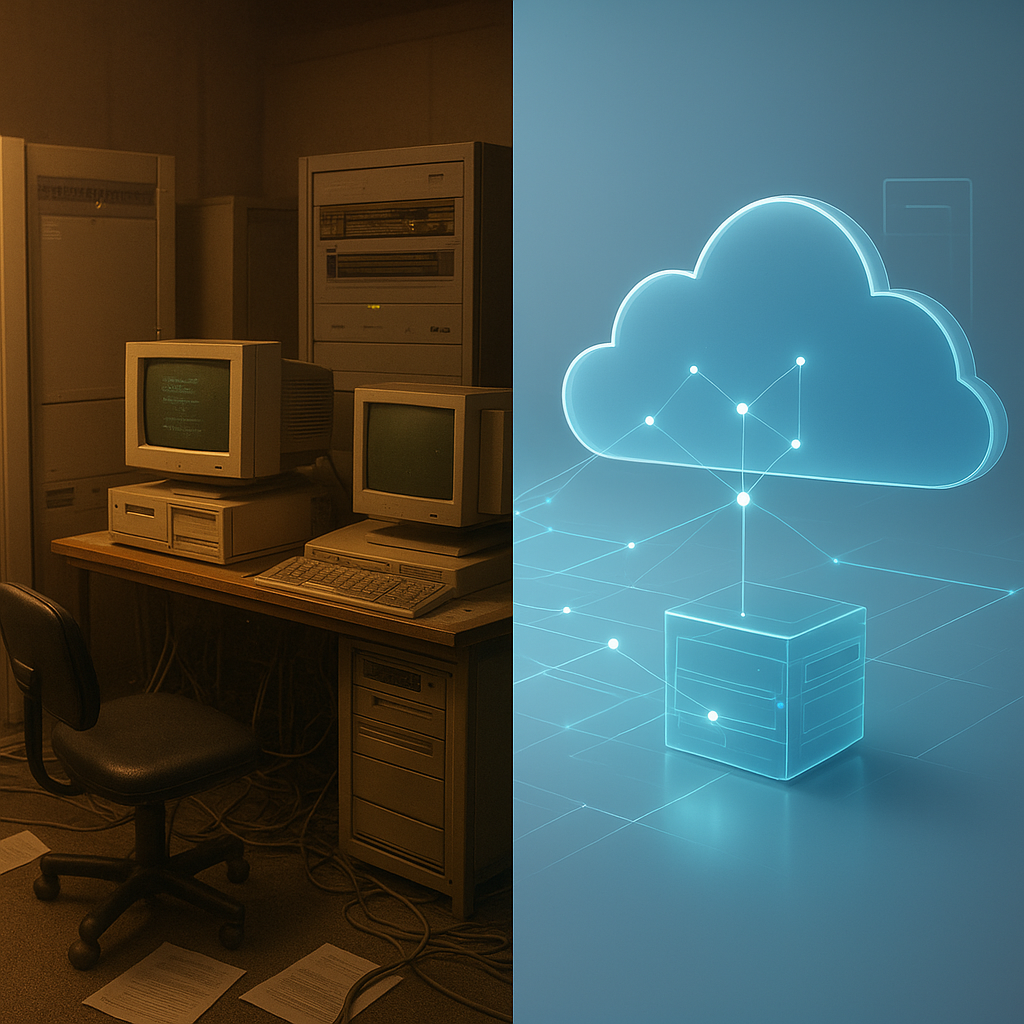
Not too long ago, “the cloud” was a phrase that raised eyebrows in boardrooms and confused looks at dinner tables. Today, it underpins everything from streaming a film on a Friday night to running mission-critical hospital systems. But the infrastructure behind cloud computing hasn’t remained static — it has gone through a series of radical reinventions that most people never stop to consider. Understanding how cloud computing architecture has evolved isn’t just a technical exercise; it reveals how fundamentally the relationship between humans and computing has shifted over the past few decades.
The Early Foundations: Mainframes and Time-Sharing
To understand where cloud architecture is now, you have to go back to where computing itself began. In the 1960s, mainframe computers were enormous, expensive machines housed in dedicated facilities. Access was tightly controlled, and computing time was a precious commodity. This gave rise to the concept of time-sharing — the idea that multiple users could share a single machine’s resources simultaneously, each accessing it through remote terminals.
This model was, in many ways, the philosophical ancestor of cloud computing. Organisations paid for access to computing power they didn’t own, delivered to them remotely. The hardware was centralised; the users were distributed. Sound familiar?
Through the 1970s and 1980s, the rise of personal computing shifted the paradigm dramatically. Processing power moved onto desks and, eventually, laps. The distributed computing model temporarily gave way to local processing, and the notion of centralised infrastructure faded from mainstream consideration — though it never disappeared entirely.
The Internet Age: Client-Server Architecture Takes Hold
The commercialisation of the internet in the 1990s set the stage for what would become modern cloud architecture. Businesses began building web applications using the client-server model, where a client (typically a browser) would send requests to a server, which would process them and return results.
This architecture was a significant step forward, but it had real limitations. Servers were physical machines, often owned and operated by the businesses themselves. Scaling meant buying more hardware — a slow, expensive process. If a server failed, services went down. Redundancy was possible but costly, requiring dedicated backup systems that sat idle most of the time.
Virtualisation technology, which began maturing in the late 1990s and early 2000s, offered a crucial breakthrough. By allowing multiple virtual machines to run on a single physical server, organisations could make far more efficient use of their hardware. This was the technical foundation upon which commercial cloud computing would eventually be built.
The Birth of Commercial Cloud: Infrastructure as a Service
The modern cloud era is generally considered to have begun in earnest with the launch of Amazon Web Services (AWS) in 2006. AWS introduced Elastic Compute Cloud (EC2), a service that allowed businesses to rent virtual computing capacity on demand. This was a genuinely transformative moment.
The architectural model underpinning these early commercial cloud services was Infrastructure as a Service (IaaS). In this model, the cloud provider manages the physical hardware, networking, and virtualisation layer, while customers manage everything from the operating system upwards. It was essentially virtualisation offered as a utility — pay for what you use, scale up or down as needed.
For businesses, the implications were enormous. Capital expenditure on servers could be replaced with operational expenditure on cloud services. Start-ups could launch global-scale infrastructure with a credit card and an internet connection. The architectural shift wasn’t purely technical; it was economic and organisational too.
Microsoft Azure followed in 2010, and Google Cloud Platform expanded significantly around the same period. By 2011, Gartner estimated the global cloud services market at approximately $91 billion, a figure that would grow exponentially over the following decade.
The Three Service Models: IaaS, PaaS, and SaaS
As cloud architecture matured, it stratified into distinct service layers, each abstracting a different amount of complexity away from the end user. Understanding these layers is fundamental to understanding how cloud architecture evolved.
Infrastructure as a Service (IaaS)
IaaS provides virtualised computing resources over the internet. Users manage operating systems, middleware, and applications, while the provider handles the underlying physical infrastructure. AWS EC2, Google Compute Engine, and Microsoft Azure Virtual Machines are canonical examples.

Platform as a Service (PaaS)
PaaS goes a step further, providing a managed environment for developing, running, and managing applications without the complexity of building and maintaining the underlying infrastructure. Developers can focus on writing code rather than configuring servers. Heroku, Google App Engine, and Azure App Service exemplify this model.
Software as a Service (SaaS)
SaaS represents the most abstracted layer — fully managed applications delivered over the internet. Users interact with software hosted and maintained entirely by the provider. Google Workspace, Salesforce, and Microsoft 365 are among the most widely used SaaS platforms in the world.
These three models form what NIST (the National Institute of Standards and Technology) codified in its widely referenced cloud computing reference architecture, which also defined the five essential characteristics of cloud computing: on-demand self-service, broad network access, resource pooling, rapid elasticity, and measured service.
Microservices and the Containerisation Revolution
Even as IaaS, PaaS, and SaaS matured, a new architectural challenge was becoming apparent. Traditional applications were built as monoliths — large, tightly coupled codebases where all components were interdependent. Deploying updates meant redeploying the entire application. Scaling meant scaling everything, even parts that didn’t need it.
The answer was microservices architecture. Rather than building one large application, developers began decomposing systems into small, independently deployable services, each responsible for a single function. These services could be developed, deployed, and scaled independently — a much better fit for the dynamic nature of cloud environments.
Microservices gained enormous traction alongside the rise of containerisation. Docker, launched in 2013, made it dramatically easier to package applications and their dependencies into portable containers. Containers could run consistently across different environments — from a developer’s laptop to a production cloud server — solving the infamous “it works on my machine” problem.
Kubernetes, originally developed by Google and open-sourced in 2014, became the dominant platform for container orchestration — managing the deployment, scaling, and operation of containerised applications at scale. By 2023, the Cloud Native Computing Foundation reported that over 96% of organisations were using or evaluating Kubernetes, a remarkable adoption rate for any technology.
Serverless Computing: Abstracting Infrastructure Away Entirely
The logical endpoint of progressive abstraction in cloud architecture is serverless computing — a model where developers write and deploy code without managing servers at all. The cloud provider handles all infrastructure provisioning, scaling, and management automatically. You simply write a function, deploy it, and pay only for the precise compute time it uses.
AWS Lambda, launched in 2014, brought serverless to mainstream attention. Azure Functions and Google Cloud Functions followed, establishing a new paradigm for event-driven, highly scalable application components. For certain workloads — particularly those with unpredictable traffic patterns or spiky demand — serverless offers compelling cost and operational advantages.
It’s worth noting that “serverless” doesn’t mean there are no servers — they simply become entirely the provider’s concern. This represents a continuation of the same abstraction trend that has driven cloud architecture from its very beginning.
Multi-Cloud and Hybrid Architectures: The Modern Reality
Today, very few large organisations rely on a single cloud provider. Multi-cloud strategies, where workloads are distributed across two or more cloud platforms, have become the norm for enterprises seeking to avoid vendor lock-in, optimise costs, and leverage the specific strengths of different providers.
Alongside multi-cloud, hybrid cloud architectures — which combine on-premises infrastructure with public cloud services — remain widespread. Regulatory requirements, data sovereignty concerns, and legacy system dependencies mean that a purely public cloud approach isn’t practical for many organisations. According to a 2023 Flexera report, 87% of enterprises described themselves as having a multi-cloud strategy, with hybrid cloud usage also remaining high.
Managing this complexity has driven significant innovation in areas like cloud-native networking, service mesh architectures, and unified management platforms that can provide visibility and control across heterogeneous environments. Tools like Istio and Linkerd have emerged to handle the complex service-to-service communication challenges that arise in distributed microservices deployments.
Edge Computing: Pushing the Boundaries of the Cloud
One of the most significant recent developments in cloud architecture is the emergence of edge computing — processing data closer to where it is generated, rather than sending everything to centralised data centres. This matters enormously for applications where latency is critical: autonomous vehicles, industrial automation, augmented reality, and the Internet of Things (IoT).
Edge computing doesn’t replace the cloud; it extends it. The architecture becomes a continuum from edge devices and local edge nodes, through regional data centres, to large centralised cloud facilities. Different types of processing happen at different points in this continuum based on latency requirements, bandwidth constraints, and data sovereignty considerations.
Major cloud providers have all developed edge computing offerings — AWS Outposts, Azure Stack Edge, and Google Distributed Cloud — reflecting how central this architectural pattern has become to the broader cloud ecosystem.
What Are the Three Basic Components of Cloud Computing?
A question that comes up frequently when people begin exploring cloud architecture is what the fundamental building blocks actually are. While descriptions vary, cloud computing is broadly built on three core components:
- Front-end platform: The client side — the device and software through which users access cloud services (browsers, applications, thin clients).
- Back-end platform: The servers, storage systems, virtual machines, and databases that comprise the cloud infrastructure itself.
- Network: The internet or intranet connections that link the front and back ends, enabling data transfer and communication between them.
These three components have remained constant even as the specific technologies within each layer have transformed dramatically. What has changed is the sophistication, scale, and abstraction at which each operates.
The Road Ahead: AI-Driven and Autonomous Cloud Infrastructure
Cloud architecture continues to evolve rapidly. One of the most significant emerging trends is the integration of artificial intelligence and machine learning directly into cloud infrastructure management. AI-driven tools are increasingly being used to optimise resource allocation, predict and prevent failures, detect security threats, and automate routine operational tasks.
The concept of AIOps — applying AI to IT operations — is maturing from a buzzword into genuine operational practice. Cloud providers are embedding machine learning capabilities into their management consoles, offering predictive scaling, intelligent cost optimisation, and automated anomaly detection as standard features rather than optional add-ons.
Quantum computing, while still in relatively early stages, also promises to eventually reshape certain aspects of cloud architecture — particularly for cryptography, optimisation problems, and scientific simulation workloads. IBM, Google, and Microsoft are all investing heavily in making quantum computing accessible via cloud interfaces.
Conclusion
The transformation of cloud computing architecture over the past six decades is a story of relentless abstraction — each generation of technology taking on more of the complexity that previously fell to the organisations and developers using it. From time-shared mainframes to virtualised infrastructure, from monolithic applications to microservices, from managed servers to serverless functions, the direction of travel has been consistent: push more infrastructure concerns to the provider, free developers and organisations to focus on what actually creates value for them.
Today’s cloud architectures — multi-cloud, hybrid, edge-integrated, increasingly AI-managed — are orders of magnitude more capable and complex than what existed even a decade ago. Yet the core promise remains the same one that time-sharing pioneers envisaged in the 1960s: computing as a utility, available on demand, without the burden of owning and operating the underlying machinery.
Understanding this evolution isn’t just historically interesting. It provides essential context for making sense of the architectural decisions and trade-offs that organisations face today, and for anticipating where cloud infrastructure is likely to go next.